
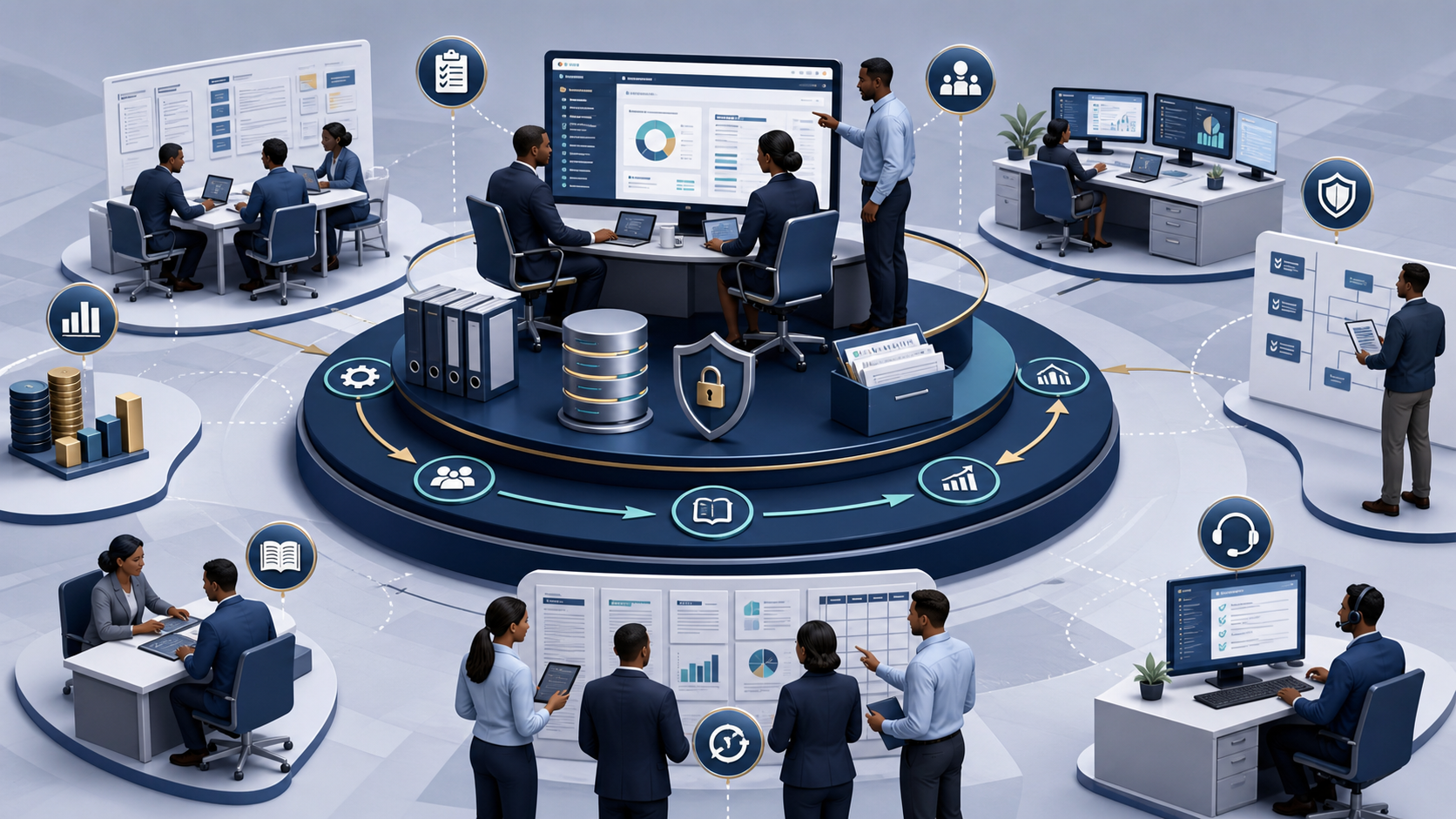
Sustainability model
Dimensions of sustainable government information systems
Institutional
Ownership, authority, staffing, and decision-making
Technical
Maintainable, secure, documented, and adaptable technology
Financial
Lifecycle funding for operation and improvement
Operational
Support, monitoring, incident management, and service continuity
Knowledge
Documentation, practical experience, and retained capability
Governance
Prioritization, oversight, risk, and accountability
Service
Continued alignment with user and policy needs
Implementation lifecycle
Sustainable implementation lifecycle
- Discover Ownership, capacity, constraints, and lifecycle costs
- Design Architecture, governance, security, data, and operating model
- Implement Together Joint delivery, documentation, testing, and knowledge transfer
- Roll Out Representative pilots, support, adoption, and refinement
- Transition Operational-readiness exercises and responsibility transfer
- Improve Continuously Performance, security, technical debt, and roadmap management
Knowledge-transfer model
Practical knowledge-transfer model
- Demonstrate The implementation team explains and performs the task.
- Shadow Government personnel observe the task in a real environment.
- Perform Together Supplier and government staff complete the task jointly.
- Reverse Shadow Government personnel lead while the supplier observes.
- Operate Independently The government team performs and documents the task without direct supplier intervention.
Independent operation can coexist with continued supplier support where the institution chooses that operating model.
Government information systems are often procured and managed as implementation projects.
A defined scope is approved. A vendor is selected. Requirements are documented. Software is configured or developed. Users are trained. The system is tested, accepted, and launched.
That sequence is necessary, but it is not sufficient.
A government system may remain in service for many years after the original implementation team has left. During that period, policies change, institutions reorganize, user needs evolve, security threats increase, integrations are modified, infrastructure reaches end of life, and new reporting requirements emerge.
A system that works on the day of acceptance may gradually become difficult to operate, expensive to change, insecure, poorly understood, or dependent on a small number of external specialists.
Sustainability must therefore be designed into the system and the engagement from the beginning.
A sustainable government information system is one that the responsible institution can:
- Operate reliably
- Understand technically and operationally
- Secure and monitor
- Maintain and improve
- Adapt to policy and organizational change
- Integrate with other public systems
- Fund throughout its lifecycle
- Govern through clear decision-making structures
- Transfer between personnel or service providers
- Retire or replace without losing essential data or service continuity
The central question is not only:
"Can the software be delivered?"
It is:
"Can the institution continue operating, governing, improving, and funding the service after the implementation project ends?"
Executive Summary
Sustainable government information systems require a lifecycle perspective.
Initial delivery should be treated as the beginning of operational responsibility, not the end of the initiative. Government institutions must be prepared to support the service, protect its data, manage vendors, resolve incidents, maintain integrations, respond to policy changes, and continuously improve the user experience.
The GOV.UK Service Standard treats public digital services as services that must be operated reliably and improved throughout their lifetime. Its live-phase guidance describes live operation as ongoing support and iteration rather than a finished delivery state.
A sustainable implementation should include:
- Clear institutional ownership
- A funded operating model
- Maintainable architecture
- Documented source code and configurations
- Automated build, testing, deployment, and recovery processes
- Knowledge transfer based on practical participation
- Administrative and technical training
- Operational runbooks
- Security and privacy management
- Monitoring and incident response
- Data-governance responsibilities
- Vendor and contract management
- Defined service levels
- Change-control procedures
- Continuous user support
- A roadmap for improvement
- Exit, transition, and replacement provisions
Knowledge transfer cannot be limited to a final training session. Government teams must participate throughout design, configuration, testing, deployment, support, and change management. World Bank guidance on government software models notes that transfer of know-how, administrator training, and support during handover should be explicitly addressed in specifications and supplier contracts.
Governance is equally important. OECD digital-government guidance consistently treats institutional models, leadership, coordination, investment management, public-sector capability, and long-term strategy as foundations for sustainable transformation.
The most successful government technology initiatives are not those that simply launch on schedule. They are those that continue delivering public value after initial funding, vendor mobilization, and executive attention have moved elsewhere.
Software delivery creates a system. Sustainable implementation creates an institutional capability.
A Government System Is a Continuing Public Service
A public information system is not only a collection of application screens, databases, and integrations.
It may be the operational mechanism through which people:
- Register a birth
- Apply for a license
- Access a benefit
- Pay a government fee
- Submit a tax return
- Register a business
- Track a court case
- Receive healthcare
- Report an incident
- Apply for a permit
- Obtain an identity document
- Interact with a public agency
When such a system becomes unavailable or inaccurate, the effect is not limited to an information technology department. Public services may stop, staff may return to paper processes, payments may be delayed, decisions may be made using incomplete information, and people may be unable to exercise rights or complete legal obligations.
This changes the definition of success.
Project delivery may be measured through:
- Milestones
- Requirements completed
- Defects closed
- Training sessions delivered
- Test cases passed
- Acceptance certificates signed
Operational success requires additional measures:
- Availability
- Reliability
- Security
- Data quality
- User adoption
- Support responsiveness
- Time to restore service
- Time to implement policy changes
- Cost of maintenance
- Ability to release improvements
- Institutional independence
- Continuity during staff and vendor changes
A system should therefore be designed and governed as a continuing public service.
Delivery Is a Milestone, Not an End State
Government technology programs frequently organize work around a fixed implementation period.
This can create an artificial division between "the project" and "operations." Development receives structured planning, staffing, funding, governance, and executive attention. Post-launch operation receives a smaller support arrangement or is expected to fit within existing institutional resources.
That transition can expose weaknesses that were hidden during implementation:
- Government administrators were trained too late.
- Technical documentation is incomplete.
- No one owns application configuration.
- Production monitoring depends on the vendor.
- Infrastructure costs were not included in future budgets.
- Source code cannot be built outside the supplier's environment.
- Security certificates expire without a renewal process.
- Integrations fail without clear ownership.
- Users have no established support channel.
- Policy changes require a new procurement.
- The internal team lacks access to repositories or deployment tools.
- The system is accepted before recovery procedures are tested.
A sustainable program plans for live operation from the beginning.
During discovery and design, the institution should identify:
- The future service owner
- Operational roles
- Required technical skills
- Support channels
- Expected service levels
- Hosting and infrastructure responsibilities
- Security responsibilities
- Data-stewardship responsibilities
- Ongoing costs
- Vendor dependencies
- Knowledge-transfer needs
- Future procurement requirements
During implementation, the future operational team should work alongside the delivery team.
Before acceptance, the institution should demonstrate that it can perform essential operational activities rather than simply confirm that the vendor has delivered documentation.
The Dimensions of Sustainability
Sustainability has several connected dimensions.
Institutional sustainability
The responsible organization has clear ownership, authority, staffing, and decision-making arrangements.
Technical sustainability
The software and infrastructure can be maintained, tested, secured, monitored, and changed without excessive effort or dependence on undocumented knowledge.
Financial sustainability
The institution can fund hosting, licenses, support, cybersecurity, connectivity, staffing, upgrades, and continuous improvement.
Operational sustainability
Users receive support, incidents are handled, data is maintained, integrations are monitored, and service levels are managed.
Knowledge sustainability
Critical understanding is retained through documentation, training, shared responsibility, repositories, and practical experience.
Governance sustainability
The institution can prioritize changes, manage risk, oversee vendors, approve releases, and resolve cross-organizational issues.
Service sustainability
The system continues to meet the needs of the public and government users as policies, expectations, and delivery channels change.
Weakness in any one dimension can affect the rest.
For example, technically maintainable software may still fail if the institution has no operating budget. A well-funded platform may remain difficult to change if knowledge is concentrated with one supplier. Strong documentation may have limited value if no government team has the authority or access required to operate the system.
Design for Maintainability
Maintainability is the ability to understand, correct, adapt, test, and improve a system over time.
It should be treated as a requirement rather than an optional technical preference.
A maintainable system generally has:
- A clear architecture
- Defined module boundaries
- Consistent coding and configuration practices
- Documented interfaces
- Automated tests
- Repeatable deployments
- Version-controlled source code and configuration
- Environment-management procedures
- Monitoring and logging
- Dependency-management processes
- Security-update procedures
- Backup and recovery capabilities
- Documented operational ownership
- Manageable infrastructure complexity
Maintainability does not necessarily require the newest technology.
A mature, widely understood platform supported by available skills may be more sustainable than a technically sophisticated solution that depends on scarce expertise.
Technology selection should consider:
- Availability of skills within the country and institution
- Vendor ecosystem
- Long-term product support
- Licensing terms
- Compatibility with government infrastructure
- Security-update history
- Interoperability
- Data portability
- Operational cost
- Accessibility
- Performance under actual connectivity conditions
- Ease of testing and deployment
- Ability to avoid unnecessary vendor lock-in
The GOV.UK Service Standard calls for technology choices that support sustainable service delivery, regular iteration, privacy, security, open standards, and reliable operation.
The most sustainable architecture is not necessarily the most complex. It is the one the institution can understand, secure, operate, and change.
Manage Technical Debt Deliberately
Technical debt includes shortcuts, outdated dependencies, incomplete tests, temporary integrations, duplicated logic, unsupported components, and architectural decisions that make future change more difficult.
Some technical debt is unavoidable. The risk arises when it is invisible or unmanaged.
Government systems are especially vulnerable because:
- Procurement cycles may delay corrective work.
- Policy deadlines may force rapid implementation.
- Maintenance budgets may be separated from delivery budgets.
- Vendors may change.
- Systems may remain in service longer than originally planned.
- Critical knowledge may leave with contractors or staff.
- Temporary interfaces may become permanent.
A technical-debt register should document:
- The issue
- The operational or security consequence
- The affected component
- The reason it was accepted
- The proposed resolution
- Estimated effort
- Priority
- Responsible owner
- Target timeframe
Technical debt should be considered during roadmap and budget decisions.
A service that receives only emergency fixes will gradually become harder and more expensive to maintain. GOV.UK lifecycle guidance distinguishes continuous improvement from basic maintenance and warns that limiting work to reactive fixes and security patches can allow underlying problems and technical debt to accumulate.
Avoid Uncontrolled Vendor Dependency
External suppliers can provide valuable specialist capability, delivery capacity, and implementation experience.
The risk is not the use of vendors. The risk is dependency without institutional control.
Warning signs include:
- The government does not control the source-code repository.
- Build and deployment procedures are undocumented.
- Only the vendor can access production.
- The institution cannot retrieve its data in usable formats.
- Configuration changes require proprietary tools available only to the supplier.
- Integration documentation is incomplete.
- The contract does not require knowledge transfer.
- Source-code ownership and usage rights are unclear.
- A replacement supplier cannot take over without rebuilding the system.
- The government cannot independently assess security or performance.
- The supplier controls key accounts, certificates, subscriptions, or domains.
Sustainable supplier relationships should preserve government control over:
- Data
- Documentation
- Source code or appropriate usage rights
- Configuration
- Administrative accounts
- Repositories
- Infrastructure definitions
- Build and deployment procedures
- Integration specifications
- Audit logs
- Backup and recovery processes
The appropriate ownership model may vary. Custom software, commercial products, software-as-a-service platforms, and open-source systems have different contractual and operational implications.
The institution should understand those implications before procurement.
The objective is not necessarily to eliminate vendor involvement. It is to ensure that the government can govern the service, change suppliers where necessary, protect its data, and maintain continuity.
Knowledge Transfer Must Be Practical
Knowledge transfer is often reduced to several training sessions and a collection of documents delivered near project closure.
That approach rarely creates operational independence.
Effective knowledge transfer should occur throughout the engagement and should include learning by doing.
Government personnel should participate in:
- Requirements analysis
- Business-process mapping
- Architecture decisions
- Configuration
- Data migration
- Integration mapping
- Testing
- Security review
- Deployment
- Incident response
- User support
- Release management
- Performance monitoring
- Change prioritization
Practical knowledge-transfer methods may include:
- Paired work between supplier and government personnel
- Joint configuration sessions
- Code and architecture walkthroughs
- Shadowing
- Reverse shadowing
- Train-the-trainer programs
- Recorded demonstrations
- Administrative exercises
- Incident simulations
- Recovery exercises
- Joint release execution
- Government-led support with supplier observation
- Competency assessments
Shadowing
Government personnel observe supplier staff performing operational tasks.
Reverse shadowing
Government personnel perform the task while supplier staff observe and provide guidance.
Reverse shadowing is particularly important because it demonstrates whether the knowledge has actually transferred.
A training attendance sheet does not prove that the institution can operate the service.
Documentation Is Part of the System
Documentation should be treated as a maintained system component.
Required documentation may include:
Business and service documentation
- Service purpose
- User groups
- Business processes
- Roles and responsibilities
- Policy dependencies
- Service-level requirements
Functional documentation
- Modules and features
- Configuration options
- User roles
- Approval workflows
- Reporting logic
- Business rules
Technical documentation
- Solution architecture
- Component diagrams
- Data model
- Integration specifications
- API documentation
- Environment configuration
- Dependency inventory
- Security architecture
Operational documentation
- Deployment procedures
- Monitoring procedures
- Backup and restoration
- Incident management
- User administration
- Certificate renewal
- Log review
- Performance management
- Disaster recovery
- Routine maintenance
Data documentation
- Data dictionary
- Code sets
- Data ownership
- Retention requirements
- Migration mappings
- Quality rules
- Archival procedures
Support documentation
- Troubleshooting guides
- Known errors
- Escalation procedures
- Contact responsibilities
- Service-level targets
- Issue classification
Documentation should have:
- An owner
- A defined location
- Version control
- Review dates
- Approval status
- Access permissions
- A process for updating it after changes
Documentation that is delivered once and never updated becomes historical evidence rather than an operational resource.
Establish Clear Governance
Government information systems often cross institutional boundaries.
A single platform may involve:
- A policy ministry
- An implementing agency
- Regional offices
- Local authorities
- A central digital-government organization
- A national data center
- Cybersecurity authorities
- Financial institutions
- Identity providers
- Development partners
- Suppliers
Without clear governance, decisions may be delayed or made inconsistently.
Governance should define:
- Executive ownership
- Service ownership
- Product ownership
- Data ownership
- Technical authority
- Security authority
- Funding authority
- Change approval
- Release approval
- Risk acceptance
- Vendor oversight
- Incident escalation
- Dispute resolution
OECD digital-government work emphasizes that coherent institutional structures, leadership roles, coordination mechanisms, investment governance, and public-sector skills are central to resilient digital transformation.
A practical governance structure may include:
Executive steering body
Provides strategic direction, resolves major institutional issues, and confirms funding and accountability.
Product or service governance group
Prioritizes improvements, reviews performance, and aligns the roadmap with user and policy needs.
Technical design authority
Maintains architecture, integration, security, and technology standards.
Data-governance body
Defines ownership, access, quality, retention, exchange, and correction responsibilities.
Operational review group
Reviews incidents, service levels, support trends, releases, and recurring problems.
Governance should be proportionate. The objective is not to create committees for every decision, but to ensure that important decisions have clear owners.
Fund the Full Lifecycle
The implementation price is not the total cost of a government information system.
Lifecycle costs may include:
- Hosting
- Connectivity
- Software subscriptions
- Database licenses
- Security products
- Technical support
- Help-desk services
- Monitoring
- Backup storage
- Disaster recovery
- Certificates and domains
- Device replacement
- Training
- Accessibility improvements
- Integration maintenance
- Data-quality work
- Security testing
- Upgrades
- Policy-driven changes
- Continuous improvement
- Future migration or retirement
Funding models should account for both predictable and uncertain work.
Predictable costs include recurring infrastructure, licenses, and routine support.
Uncertain costs include:
- Security vulnerabilities
- Policy changes
- Increased usage
- New integrations
- Supplier changes
- Technology obsolescence
- Emergency response
- Regulatory requirements
OECD guidance on digital-government investment stresses the need to manage public technology investment strategically, balance internal capacity with partnerships, and align budgeting practices with modern digital-service needs.
GOV.UK lifecycle guidance similarly recommends planning people and resources for reliable operation and continuous improvement throughout a service's lifetime.
A system without an operational budget is not sustainable, regardless of the quality of the initial implementation.
Build an Operating Model Before Go-Live
The operating model describes how the service will function after deployment.
It should define:
- Service owner
- Product owner
- Technical owner
- Data owners
- Support levels
- Support hours
- Incident priorities
- Service-level targets
- Escalation routes
- Monitoring responsibilities
- Release procedures
- Change-control procedures
- Security responsibilities
- Backup and recovery ownership
- Vendor obligations
- Reporting arrangements
A practical support model may use three levels.
Level 1: User and service support
Handles common user questions, password issues, basic navigation, known errors, and initial issue classification.
Level 2: Application and configuration support
Handles permissions, workflow configuration, data corrections, reports, failed jobs, integrations, and application-level investigation.
Level 3: Engineering and infrastructure support
Handles defects, architecture, performance, security, databases, infrastructure, and complex integrations.
Ownership should be clear when several organizations participate.
An incident should not remain unresolved because each organization assumes another party is responsible.
Treat Security as Continuing Work
Security does not end when a penetration test is completed before launch.
Government systems face continuing changes in:
- Threats
- Vulnerabilities
- User access
- Vendors
- Dependencies
- Infrastructure
- Policies
- Data sensitivity
- Integration partners
Sustainable security requires ongoing processes for:
- Vulnerability management
- Patch management
- Secure configuration
- Access review
- Privileged-account management
- Logging and monitoring
- Incident response
- Backup testing
- Disaster-recovery testing
- Dependency review
- Certificate renewal
- Security testing
- Supplier-risk review
- Staff awareness
- Data-retention enforcement
The institution should know who has authority to:
- Disable an account
- Suspend an integration
- Isolate a component
- Restore from backup
- Notify affected stakeholders
- Accept a security risk
- Take the service offline
The service should also maintain a tested continuity process.
A backup is useful only when the institution can restore it within the required timeframe.
Protect Data as an Institutional Asset
Government systems may store information that must remain usable beyond the lifespan of a particular application.
Sustainability therefore requires data governance and portability.
The institution should understand:
- What data the system holds
- Who owns it
- Who may access it
- Which fields are authoritative
- How quality is measured
- How corrections are made
- How long records are retained
- How records are archived
- How data can be exported
- How data will be transferred to a future system
- How sensitive information is protected
Data should not be trapped in a format that only the original supplier can interpret.
Contracts and technical designs should address:
- Documented schemas
- Export formats
- Code sets
- Metadata
- Data dictionaries
- Historical records
- Attachments
- Audit trails
- Migration assistance
- Data deletion after transition
Digital public infrastructure and data exchange depend on governance, safeguards, capacity, and institutional ownership - not merely shared technical components. UNDP and OECD both frame sustainable digital infrastructure as requiring governance and enabling public-sector capacity.
Implementation Support Is More Than Training
Users may understand a new system during formal training and still struggle when applying it to real cases.
Implementation support should account for:
- Real workloads
- Unusual cases
- Incomplete data
- Policy exceptions
- Differences between offices
- Local connectivity
- User confidence
- Supervisory practices
- Existing paper processes
- Competing responsibilities
Useful implementation-support methods include:
- Super-user networks
- Floor-walking or onsite support
- Remote support channels
- Office hours
- Frequently asked questions
- Short task-based guides
- Recorded demonstrations
- Manager briefings
- Refresher training
- Usage monitoring
- Feedback sessions
- Issue triage
- Configuration refinement
- Phased rollout
The goal is not only to teach users which buttons to select. It is to help the institution adopt a new operating process.
Implementation support should also identify when the system design is creating the problem.
Repeated user errors may indicate:
- Unclear interface design
- Poor terminology
- Excessive data requirements
- Inconsistent business rules
- Missing validation
- Inadequate access permissions
- A workflow that does not reflect actual operations
User support should feed continuous improvement rather than merely close tickets.
Procurement Should Include Sustainability
Sustainability requirements should appear in procurement documents and contracts.
Relevant requirements may cover:
Architecture and technology
- Supported technology
- Open standards
- Documented interfaces
- Data portability
- Scalability
- Accessibility
- Security
- Maintainability
Source code and configuration
- Repository access
- Ownership or usage rights
- Source-code delivery
- Build instructions
- Configuration documentation
- Dependency inventory
- Infrastructure definitions
Quality assurance
- Automated testing
- Security testing
- Performance testing
- Recovery testing
- Code review
- Defect management
Knowledge transfer
- Government participation
- Administrator training
- Technical training
- Shadowing
- Reverse shadowing
- Competency validation
- Documentation updates
Operations
- Support levels
- Service-level targets
- Monitoring
- Incident response
- Release management
- Maintenance periods
- Upgrade responsibilities
Transition and exit
- Data export
- Repository transfer
- Administrative-account transfer
- Handover support
- Replacement-supplier cooperation
- Data deletion
- Transition timelines
Acceptance criteria should test institutional readiness, not only system functionality.
Validate Operational Readiness
Before go-live or final acceptance, the institution should demonstrate that it can perform essential activities.
Operational-readiness exercises may include:
- Deploying a release
- Rolling back a failed release
- Creating and disabling users
- Restoring a backup
- Responding to a simulated incident
- Renewing a certificate
- Resolving a failed integration
- Updating a workflow
- Producing a required report
- Recovering from service interruption
- Exporting institutional data
- Applying a security update
- Escalating a high-priority support issue
The government team should lead selected exercises while the supplier observes.
Evidence should include more than a demonstration performed solely by the vendor.
Handover is complete when the receiving institution can perform essential tasks—not when the final document has been submitted.
A Phased Sustainability Model
Phase 1: Institutional discovery
- Identify the service owner.
- Map stakeholders and decision rights.
- Assess current capacity.
- Identify future operational roles.
- Estimate lifecycle costs.
- Document constraints.
Phase 2: Sustainable design
- Select maintainable technology.
- Define architecture and standards.
- Establish data ownership.
- Design security and monitoring.
- Define the future operating model.
- Include transition requirements.
Phase 3: Joint implementation
- Pair supplier and government teams.
- Create documentation continuously.
- Establish repositories and environments.
- Configure monitoring.
- Build automated tests.
- Begin administrator training.
Phase 4: Controlled rollout
- Pilot with representative users and offices.
- Operate the support model.
- Track incidents and adoption.
- Refine workflows.
- Validate infrastructure and capacity.
- Update documentation.
Phase 5: Operational transition
- Conduct reverse shadowing.
- Complete readiness exercises.
- Confirm budgets and staffing.
- Transfer accounts, repositories, and responsibilities.
- Establish service reporting.
- Agree on remaining supplier support.
Phase 6: Continuous improvement
- Review performance.
- Prioritize improvements.
- Manage technical debt.
- Maintain security.
- Update skills.
- Reassess vendor dependencies.
- Plan modernization and eventual retirement.
Common Failure Patterns
Treating go-live as completion
The implementation team disbands before the operating model is established.
Delaying knowledge transfer
Training occurs near project closure when there is little time for practical participation.
Depending on one specialist
Critical knowledge is concentrated with a single employee or contractor.
Accepting incomplete documentation
The system works, but architecture, integrations, configurations, and procedures are not adequately documented.
Funding development without operation
The budget covers implementation but not infrastructure, support, security, and improvement.
Choosing technology without considering local capacity
The system depends on skills that the institution cannot retain or obtain affordably.
Failing to control repositories and accounts
The supplier retains exclusive control over source code, deployment tools, subscriptions, or production access.
Allowing technical debt to remain invisible
Shortcuts become permanent and eventually make changes expensive or unsafe.
Measuring training attendance instead of capability
Personnel attend sessions but cannot independently complete operational tasks.
Treating support as a temporary stabilization activity
The institution has no long-term user-support or incident-management model.
Ignoring data portability
The government cannot readily move its information to another platform.
Creating governance without decision authority
Committees meet but cannot resolve priorities, funding, security, or ownership issues.
Over-customizing the system
Complex custom features make upgrades, maintenance, and supplier transitions difficult.
Failing to plan retirement
Data, users, integrations, and public channels become dependent on a system with no transition strategy.
Practical Principles for Sustainable Government Systems
- Treat the system as a continuing public service.
- Assign an accountable institutional owner before development begins.
- Design the operating model alongside the software.
- Select technology the institution can support.
- Keep architecture understandable and appropriately simple.
- Maintain source code, configuration, and documentation under institutional control.
- Use open standards and documented interfaces.
- Make knowledge transfer continuous and practical.
- Use reverse shadowing to verify operational capability.
- Fund the full lifecycle.
- Establish monitoring, support, and incident response before go-live.
- Manage technical debt deliberately.
- Protect data portability.
- Define vendor-transition and exit requirements.
- Include government personnel in design and implementation decisions.
- Validate backup, recovery, and continuity procedures.
- Use support data to improve the service.
- Measure institutional capability as well as software delivery.
- Maintain a roadmap after launch.
- Plan for eventual modernization, migration, or retirement.
Measuring Sustainability
Sustainability measures should extend beyond initial delivery.
Technical health
- Availability
- Incident frequency
- Time to restore service
- Deployment frequency
- Failed deployment rate
- Test coverage
- Unsupported dependencies
- Security vulnerabilities
- Backup and recovery success
- Technical-debt backlog
Institutional capability
- Operational tasks performed independently
- Government personnel with required competencies
- Dependence on individual specialists
- Documentation completeness
- Knowledge-transfer progress
- Percentage of support handled internally
Service performance
- Completion rates
- User satisfaction
- Support volume
- Time to resolve requests
- Accessibility issues
- Adoption across offices
- Manual workarounds
- Error and correction rates
Governance
- Time to approve changes
- Unresolved ownership issues
- Roadmap review frequency
- Risk-review completion
- Vendor-performance review
- Data-quality governance
Financial sustainability
- Forecast operating cost
- Budget coverage
- License and infrastructure utilization
- Cost of major changes
- Unplanned support costs
- Cost of supplier dependence
The GOV.UK Service Standard recommends defining service success through performance measures and user research, then using that information to guide improvement.
The Pillarsis Approach
Pillarsis approaches government technology as an institutional-capability engagement supported by software engineering.
Our work begins by understanding:
- The public service being delivered
- The institutions involved
- User needs
- Existing processes
- Policy and regulatory requirements
- Data ownership
- Operating conditions
- Technical capacity
- Governance
- Long-term funding and support expectations
We design implementation and sustainability together.
Our approach emphasizes:
- End-to-end business-process mapping
- User-centered service design
- Maintainable architecture
- Secure software engineering
- Open and documented interfaces
- Configuration management
- Data governance
- Automated quality assurance
- Monitoring and auditability
- Practical knowledge transfer
- Government-team participation
- Administrative and technical documentation
- Operational readiness
- Application maintenance
- Continuous improvement
Pillarsis does not treat knowledge transfer as a final project activity. We integrate government personnel into analysis, configuration, validation, deployment, support, and change management.
Our objective is not only to deliver a working system.
It is to help establish a government service that can remain reliable, understandable, secure, adaptable, and institutionally owned after the initial engagement.
Sustainable Systems Strengthen Public Institutions
Government information systems increasingly support essential public services.
Their success cannot be judged only by whether software was delivered, requirements were completed, or a launch event occurred.
A sustainable system must remain useful after policies change. It must remain secure after new threats emerge. It must remain understandable after personnel and suppliers change. It must remain maintainable after the original implementation budget ends.
That requires deliberate investment in:
- People
- Governance
- Documentation
- Architecture
- Security
- Support
- Data
- Funding
- Knowledge
- Continuous improvement
Software can be transferred through a repository.
Institutional capability must be built through participation, practice, ownership, and time.
The strongest government technology engagement is therefore not one that makes an institution permanently dependent on the implementation partner.
It is one that creates a reliable system, establishes accountable operational ownership, transfers practical capability, and leaves the institution better prepared to govern future digital services.
Selected Authoritative Resources
- OECD, The OECD Digital Government Policy Framework.
- OECD, The E-Leaders Handbook on the Governance of Digital Government.
- OECD, Effectively Managing Investments in Digital Government.
- OECD, Digital Public Infrastructure for Digital Governments.
- UNDP, Digital Public Infrastructure.
- UNDP Digital Strategy.
- World Bank guidance on government software delivery models and transfer of know-how.
- GOV.UK Service Standard.
- GOV.UK guidance on managing and improving public services through their lifecycle.
Build Government Systems That Endure
Pillarsis helps governments, public institutions, and development organizations design, implement, and operate secure information systems built for maintainability, institutional ownership, and long-term public value.